
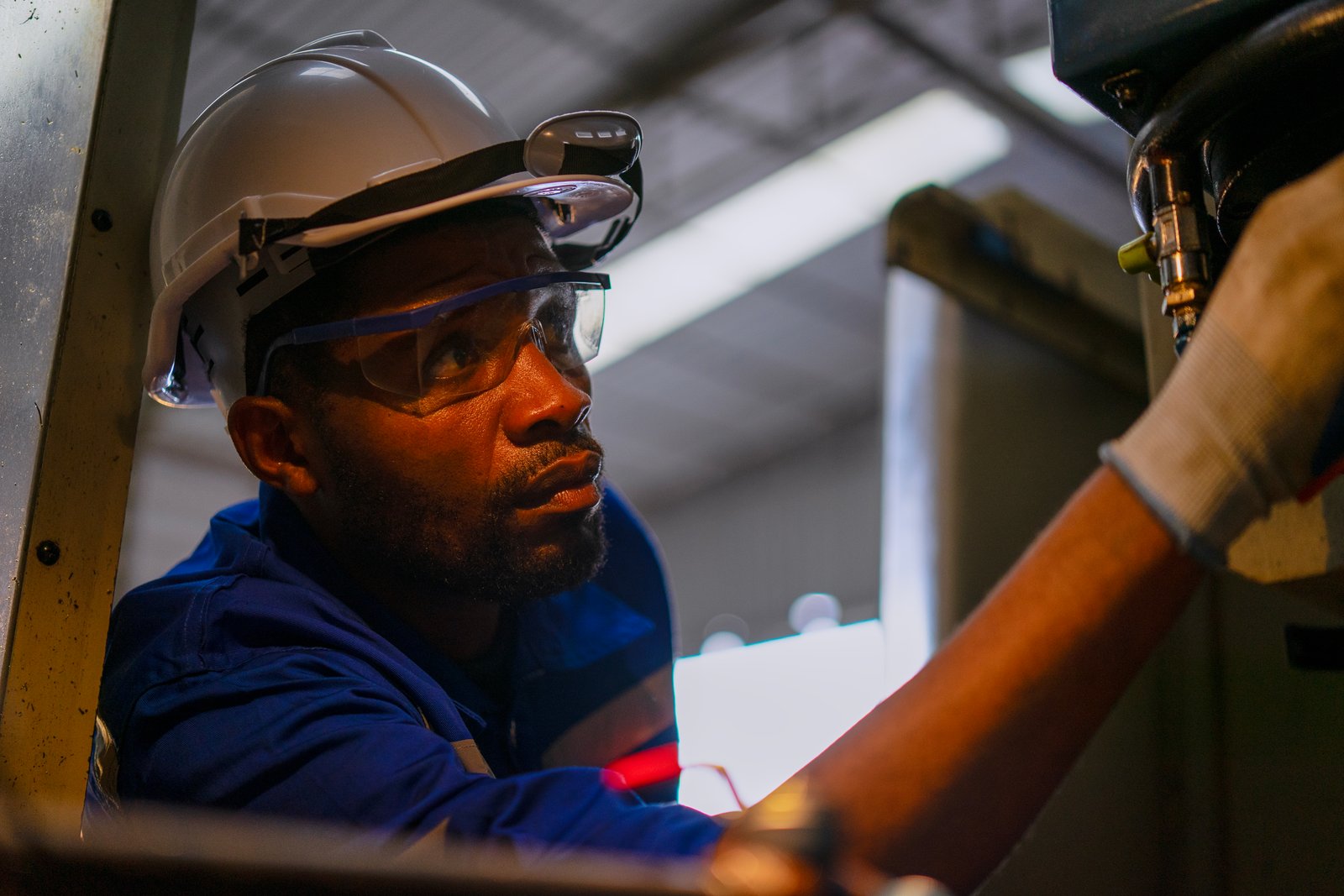
Millwright insurance is the set of business policies a millwright contractor carries for work done on machinery that belongs to someone else, inside a building that belongs to someone else. It answers for injury and damage around the job, for a setting or plan that proves wrong, for the customer’s machine while your crew has charge of it, and for your own people, trucks and tools, assembled as one program instead of bought a policy at a time.
This page is the map of that program. It starts with the work, because an underwriter starts there, then follows the service lines a millwright company sells: contracting, rigging and field fabrication, each with its own exposure and the coverage that answers it. After that come the pieces that tie the program together: how the policies fit, what a plant demands before it lets your crew in, what moves the price and what to gather before you ask for a quote. Millwright contractor insurance and millwright business insurance are other names for the same program, and each policy in it has a page of its own linked from here.
Who millwright contractors are
A millwright is the tradesperson a plant calls when a machine has to arrive, stand level, run true or leave. The work begins where the truck is unloaded and ends when the line runs: a base set on its foundation, anchor bolts placed and grouted, a motor brought into alignment with the shaft it drives, guards and supports fitted so the machine can be started safely. Some companies are an owner and a helper with a truck of jacks and skates. Others run several crews from a yard, keep a fleet of rigging gear and hold standing agreements with plants across state lines.
The customers are plants and the firms that build and service them: food and beverage lines, paper and packaging mills, power stations, water treatment works, distribution centers, foundries and steel mills. Some hire the millwright directly. Others reach the trade through a general contractor or an engineering firm holding the prime contract. Either way the insurance has to satisfy a party that is not paying the premium, and that fact shapes every policy below.
The work an underwriter will ask about
An application for a millwright company reads the work one service at a time, because each service changes what can go wrong and whose property it happens to.
- Equipment setting and alignment. Precision work whose result the plant relies on for years. The exposure is a tolerance missed and a machine held in your care until it runs.
- Machine moving and plant relocations. A route through a finished building, a trip on a trailer and a restart in a new place, with the machine exposed at every stage.
- Rigging. The pick itself: gantries, jacks, chain falls and cranes taking a load the customer prizes off the floor and setting it down again.
- Plant maintenance and shutdowns. Repairs on a deadline inside a running plant, beside its staff and other contractors, where a failure afterwards is measured in lost production.
- Field fabrication. Supports, stands, guards and platforms cut and welded on site, which brings hot work and load-bearing steel into the account.
Millwright contractor work: setting, moving and servicing machinery
The contracting line is the heart of the trade, and its exposure has two faces. The first is custody: from the moment your crew takes a machine off the truck until the plant accepts it as running, that machine is in your hands, and standard liability wording sets property in your care aside. The second is reliance: the plant pays for an alignment, a level base or a relocation layout because it will run production on the result, and when the result is wrong the loss arrives later, as worn parts and idle hours, with no accident to point to.
A relocation stretches both faces across distance. The machine is disconnected, rolled through doorways and across floors that were never rated for it, loaded, hauled, perhaps stored while the new building is readied, then set and started again. A maintenance shutdown compresses them into time: the plant is paying for every hour of the outage, your crew may work nights beside the plant’s own staff, and a bearing or coupling you replaced is judged the morning the line restarts.
The coverage that answers contracting work
- Riggers’ liability and installation floaters come first here: they answer for the customer’s machine while it is in your care, in transit or waiting to be accepted.
- General liability answers for the plant around the job: its people, its building and the equipment you were not hired to touch, and for finished work that injures someone later.
- Professional liability answers for the setting, layout or plan that was simply wrong.
- Workers’ compensation and commercial auto cover the crew and the trucks that carry it from plant to plant.
Rigging: the lift, the load and the gear under it
Rigging concentrates a millwright company’s risk into moments. A sling angle, a pick point, a shackle rated for the wrong load or a floor that gives under a gantry leg decides whether the day ends with a set machine or a dropped one. The load is the customer’s, the gear may be yours or rented, and the people standing nearby belong to the plant.
Rigging insurance, and what riggers’ liability covers
Rigging insurance is the name owners search for; riggers’ liability is the coverage underneath it. It is written for damage to property you are lifting, moving or setting for someone else, the exact loss a general liability policy steps away from, and it is arranged in the riggers’ section of the property page, where it sits beside the installation floater. The limit on it should be measured against the costliest machine your crews will handle, not the average one.
Your own rigging gear is a separate question. Gantries, jacks, skates, chain falls and spreader bars travel from plant to plant, and contractor’s equipment coverage follows them; rented gear in your care can be added to the same coverage. Cranes bring an auto question of their own, because whether a particular crane is treated as a vehicle or as equipment depends on the policy wording, so name every crane on the application. A dropped load that injures a plant worker or wrecks a neighboring line is general liability ground, and a plant that writes high limits for lifting work is the usual reason an umbrella enters the program.
Metal fabrication as a millwright service line
A millwright crew cuts and welds steel because the machine needs it: a base plate that lands on an uneven slab, shims, a stand to raise a motor, a guard the plant’s safety office asked for, a platform so operators can reach a control panel. The steel is part of the installation, built in the customer’s building and left there.
Metal fabrication insurance for steel built in the field
Metal fabrication insurance, for a millwright, means the coverage that follows that field work. Hot work comes first: a spark that reaches dust, oil or stored material can start a fire far bigger than the job, which is general liability ground, and a plant can attach permits and a fire watch to it. Load-bearing steel comes second: a platform or support that gives way after you leave is a completed-work claim under the same policy, and if your company designed the support as well as built it, professional liability deserves a look. Welders, torches and plasma cutters are contractor’s equipment on the property side, and burns and eye injuries on the crew are workers’ compensation claims.
The line has a boundary. This program treats fabrication as part of an installation. An operation whose business is building steel products in its own building for sale to others is a different account, written on different terms, and is not quoted here.
Other names for the same program
Owners look for this insurance under several names, and each of them lands here. Rigging insurance and riggers’ insurance point to the rigging section above. Machinery moving insurance describes the relocation work, and it is the same program with the transit and storage stages written in. Equipment installation insurance, in this trade, means setting industrial machinery on its foundation and aligning it, the contracting work described above, not the installation of communications or building systems. Metal fabrication insurance, for a millwright company, means the field work in the fabrication section, not a business that builds steel for sale.
Setting, moving and servicing machinery puts the customer’s machine in your care, answered by riggers’ liability and installation floaters, and stakes the plant’s production on your settings and plans, answered by professional liability. Rigging can drop or swing a load into the plant around it, which general liability answers for the plant while the riggers’ coverage takes the load, and it runs on gantries, jacks and rented gear covered as contractor’s equipment. Field fabrication brings hot work, where a fire in the plant is general liability ground under the plant’s permit terms, and welded supports whose failure after turnover is a completed-work claim. The policies themselves set the exact terms. No figures are shown.
How the policies fit together
The order in which a millwright program is assembled follows the gate at the plant. Some lines are the price of entry: a plant will not badge a crew without general liability, workers’ compensation and auto. One line is the price of doing this trade at all: the riggers’ and floater coverage for the customer’s machine. The rest are sized to the work and the contracts: professional liability for the companies that sign off on tolerances and plans, and the umbrella for the plants that ask for more limit than the primary policies carry.
General Liability
The claim from outside the company: a plant worker hurt by your work, a building or a neighboring line damaged by it, and finished work that fails after the plant has taken it back.
Professional Liability
The claim with no accident in it: a tolerance, a layout or a relocation plan the plant relied on that turned out wrong and cost it output.
Property Insurance
Your yard and tools, and the riggers’ liability and installation floater coverage for the customer’s machine from the moment your crew takes charge of it.
Workers’ Compensation
The crew itself: medical care and lost pay after an injury on the job, with employer’s liability behind it if the injury becomes a lawsuit.
Commercial Auto Insurance
The road: crew trucks, service bodies, tractors and the trailers that carry gantries and machines, plus rentals and employees’ own vehicles on company errands.
Umbrella Insurance
The height a plant contract asks for: liability limit stacked over general liability, auto and employer’s liability.
The coverage overview lists the same policies with a line each, and every card above opens the full page for that policy.
At the center sits the plant’s contract exhibit. Additional insured status and wording that makes your policy respond ahead of the plant’s own both land on general liability. A waiver of the insurer’s right to recover from the plant can be asked of liability, auto and workers’ compensation. A stated limit for each line is met by the primary policies and the umbrella above them. The plant’s machine while your crew has it is answered by the riggers’ coverage. Proof before your crew is badged comes from the certificate, which reports what the policies already say. The endorsements on each policy set the exact terms. No figures are shown.
What a plant asks for, and which policy carries it
A plant’s insurance requirements arrive as an exhibit to the contract or a packet from its purchasing office, and each request lands on a particular policy. Additional insured status and the plant’s indemnity terms land on general liability, along with wording that makes your policy respond ahead of the plant’s own. A waiver of the insurer’s right to recover from the plant can be asked of general liability, auto and workers’ compensation alike. A stated limit per line is met by the primary policies and, above them, the umbrella. And a plant that has thought about its equipment will ask how its machine is covered while your crew has it, which only the riggers’ coverage answers.
The certificate is how the plant checks, and it reports only what the policies already say. Keeping it current is a working habit: a new certificate for each plant that asks, renewed certificates sent before the old ones expire, the plant’s portal updated when a policy changes, and a certificate in your file for every subcontractor you bring onto the job. A prime contractor above you will expect the same from your company that you expect from your subs.
Claims a millwright program is built for
- The press that slid off its skates. A move across a sloped floor, a skate that turns, a frame that cracks on impact: the customer’s machine, answered by the riggers’ coverage.
- The line that stopped after restart. A shutdown repair that met the schedule and failed under load, and a plant that blames the alignment for the lost run: a professional liability question.
- The spark in the dust collector. Field welding near a duct the plant had not cleaned, and a fire through the bay: general liability, and the umbrella above it if the damage runs past the primary limit.
- The jack that kicked. A hydraulic jack shifts under a base and catches a helper’s hand: workers’ compensation.
- The lowboy on the off-ramp. A loaded trailer leaves the road with a customer’s compressor on it: auto for the crash, the floater for the machine.
A well-run job can produce every one of these, and no single policy pays for more than one or two of them.
What moves a millwright quote
Two millwright companies of the same size can see very different quotes, and the reasons sit in the work. The mix of services matters: rigging and hot work read differently from alignment and maintenance. The value of the machines you handle sets the riggers’ limit and its price. Payroll, split by the kind of work each person does, drives workers’ compensation. Owned and rented cranes, the number and kind of trucks and trailers, the drivers and their records, and the distance your crews travel all move the auto side. Plant contracts that demand higher limits or particular endorsements add to the cost, and so does a loss history. A long record in the trade and the habits described below can move it the other way.
Work that crosses state lines
Workers’ compensation, contractor registration and the safety rules a plant follows differ from one state to the next, and a shutdown crew that travels takes those differences with it. Our state pages cover the states where we place millwright work. Before a crew leaves for an outage in another state, tell the agent where it is going so the policies can be set for it.
The records that speak for your crew
A millwright application is a set of answers; the paperwork behind it is the proof. A lift plan drawn up before a heavy pick, a log of sling and shackle inspections, the alignment readings filed with each job, a hot-work permit signed and countersigned, a record of who on the crew is qualified for which task: an underwriter who sees those can price the company as it actually works rather than as an unknown. How long the owner has worked the trade, and how long the company has, belongs in the same picture.
Insurers draw their lines in different places. One may write alignment and maintenance gladly and balk at crane picks; another may avoid a particular kind of plant. An exclusion or a declined quote is a signal to take that piece of the work to an insurer whose appetite includes it. Dropping the work from the application to get a cleaner quote only moves the problem to the day of the claim.
What to gather before you ask for a quote
- The services you sell, and roughly how the year divides among them.
- The costliest machine your crews expect to handle, and the kinds of plants you work in.
- Your own equipment, owned and rented, with values: gantries, jacks, skates, welders and cranes.
- Trucks, trailers and the people who drive them.
- Payroll by kind of work, and what you pay subcontractors.
- The states your crews work in.
- The insurance exhibits from the plant contracts you sign, and your current policies and claims history.
Why Millwright Business Insurance
Wexford Insurance, LLC runs this site for millwright contractors and no other trade, and Nate Jones, CPCU, reviews each page before it is published. That focus shows up in the questions we raise before a quote goes out: the clause in the plant’s exhibit, the crane on the equipment schedule, the relocation that crosses a state line. You can read about who we are, or go straight to the quote request.