
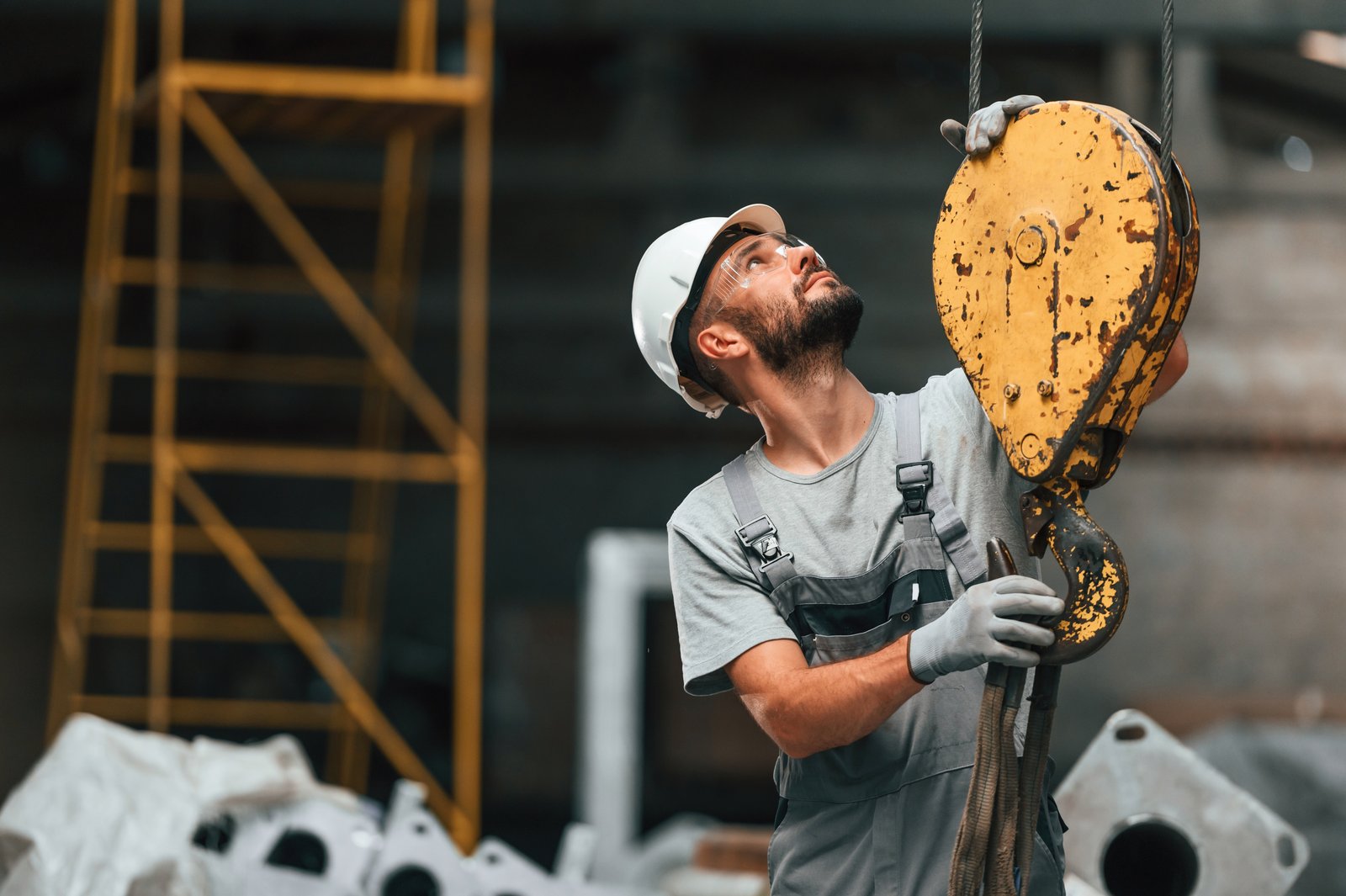
A millwright contractor’s general liability policy answers when someone outside the company says your crew hurt them or broke something of theirs: it pays the claim it covers and hires the defense, whether or not the accusation holds up. A plant reads this line of your certificate before any other, and every other policy in a millwright program is arranged around it.
The trade puts that policy under unusual strain. Your crew works inside a building you do not own, beside people you do not employ, under equipment that keeps running while you work. The thing you came to move is worth more than your trucks. And the work goes on answering for itself long after you leave, every time the line it feeds is switched on. A general liability policy handles some of that very well and some of it not at all, and a millwright owner needs to know which is which before the purchase order arrives.
Strangers, their property and the hand-offs
Picture a plant mechanic struck by a swinging chain hoist, a visitor who trips over your cribbing, a conveyor bent by your pallet jack, a forklift pinned against a column when a load shifts. None of those people or things belongs to your company, and that is the test the coverage applies. The policy travels with the crew from plant to plant within its territory. As standard forms are written, defense costs for a covered suit are paid in addition to the limit; personal and advertising injury is included; and a modest medical payments coverage can settle a small injury without a fight over fault.
The same test sends other losses elsewhere. Jacks, skates, gantries and alignment lasers are things you own, which puts them under property insurance and its contractor’s equipment section. Your own people, hurt at work, are a workers’ compensation matter; the crew truck in a wreck is a commercial auto matter; and a setting that was simply wrong, with no accident, is a professional liability matter. The customer’s machine in your rigging is the hardest case of all, and a section further down takes it on its own.
Inside a running plant
The first stretch of exposure is the job itself, what the form calls ongoing operations, and the setting is what makes millwright work distinctive. A plant does not always stop for a contractor: production lines run on either side of the bay you have taped off, forklifts keep moving through the aisles, and the plant’s own maintenance crew may be working on the same equipment from the other side.
That density puts other people’s property inside your swing radius. The tilt of a machine on a gantry can reach a control cabinet, a sprinkler main or a neighboring press. A path cut for a move can lift tiles, tear floor coatings or crack a slab that was never rated for a concentrated load. An anchor drilled in the wrong place can hit a buried conduit and take down a line you never touched. None of that is the equipment you were hired to handle; it is the plant around it, and damage to the plant around the job is squarely what this policy was written for.
It also puts people in the way. A plant employee hurt by your work is a third party to your company even when the plant’s own workers’ compensation pays the medical bills, and that employee, or the plant’s insurer, may look to your company for the rest. Claims like that are the reason the policy exists, and in a contested one the lawyers your insurer hires can be worth as much to you as the check that settles it.
The bid and the contract come first, where the indemnity clause and the additional insured terms are agreed. Ongoing operations follow, where injury to plant staff and damage to the building around the work sit inside the policy. The lift, move and set stage is marked apart, because the customer’s machine in your care is excluded from general liability and answered by riggers’ and floater coverage. Turnover and sign-off come next, when the alignment readings and anchor records become the job’s evidence. Completed operations close the flow: a guard, base or platform that fails later and injures someone or damages other property. Where a given claim lands is settled by the policy’s own form. No figures are shown.
After the machine is set
The job ends with a handshake and an alignment report. The exposure does not. A guard you installed works loose and an operator’s hand goes where the guard was. A grouted base settles and the machine on it walks into the line next to it. A coupling you assembled lets go at speed and throws parts across the bay. Those losses can arrive months after the invoice. General liability takes them up through the products-completed operations hazard, the part of the form that looks back at finished work done away from your yard, and it carries a separate aggregate for them.
The coverage comes with limits of its own. The policy answers for what the failed work does to people and to other property; standard forms exclude damage to your own work, so the cost of redoing the installation itself is a separate matter. Standard general liability forms use an occurrence trigger: whichever policy was in force on the day of the injury or damage is the one that responds, so a policy you replaced can still be the one that pays. Check the trigger on your own form. And file the alignment readings, torque values and anchor records for every job; years later they are the only witness to how the work was left.
Where the work was right and the result still disappointed, the claim may not belong here at all. An alignment held to the tolerance the plant specified that still wears out a bearing, or a relocation plan that cost a week of production, is a dispute about advice and precision with no accident behind it, which is what professional liability is written to answer.
Steel you build on the job
A millwright job can include steel the crew cuts, fits and welds on site: a mezzanine platform beside the new machine, a set of stairs up to it, a guard rail around the opening, a pipe rack, a sole plate or the brackets that carry a conveyor. That steel stays in the plant and goes on carrying people and loads for years.
A platform that fails under a maintenance worker, or a bracket that drops a conveyor section onto the line below, is read under the same products-completed operations hazard as any finished work. Tell the agent that field fabrication is part of your jobs, and roughly what kind, because an application that describes only setting and alignment may be priced and worded for a narrower operation than the one you run. The steel is part of the millwright job, and the policy should know it is there.
At the base sits your general liability policy: injury and damage to others, defense and completed operations. Above it, coverage for an insured contract answers for liability you take on through the plant’s indemnity clause, as the form defines that term. Next, additional insured status lets the plant tender a claim arising from your work to your insurer. Primary and noncontributory wording puts your policy ahead of the plant’s own. A waiver of subrogation gives up your insurer’s recovery against the plant. At the top, an umbrella carries higher limits when the contract asks for more than the base policy holds. Each layer is an endorsement or a policy, and its wording decides its reach. No figures are shown.
When the plant writes the terms
Every plant job runs under a purchase order or a contractor agreement, and the insurance exhibit attached to it reaches straight into the general liability policy. Its terms are met by the policy’s wording and its endorsements, never by the certificate that reports them.
The indemnity clause. The contract will ask your company to hold the plant harmless for injuries and damage arising from your work, sometimes including injuries the plant helped cause. Standard general liability forms cover liability you take on under an insured contract, as the form defines one, which can let the policy answer for the promise you signed. Whether it does depends on the clause and the definition side by side.
Additional insured status for the plant. This lets the plant tender a claim arising from your work directly to your insurer. The endorsement wording decides its reach: whether it covers the plant only during your ongoing work or also after completion, and whether it reaches claims partly caused by the plant’s own people. A contract that asks for completed operations coverage for the plant needs an endorsement that grants it.
Primary and noncontributory wording, and the waiver. The plant will want your policy to answer ahead of its own without asking the plant’s insurer to share, and your insurer to give up recovery against the plant. Each of those is a separate endorsement, and a certificate that mentions one the policy lacks protects nobody.
The machine in your rigging is not a general liability loss
Standard general liability forms exclude property damage to personal property in the care, custody or control of the insured. For a millwright crew, the moment a customer’s machine is unbolted, rigged, lifted onto skates or hung from a gantry, it is in your control, and it stays there until it is set, anchored and handed back. A spindle bent in the drop, a gearbox cracked against a column, a press tipped off its rollers: each is damage to property in your care, and general liability does not answer it.
The line is narrow and it matters. The floor the machine was rolling over, the column it struck and the line next to it are still the plant’s property outside your control, and damage to them is read as the earlier sections describe. The machine itself is not. The coverages written for it are riggers’ liability, contractor’s equipment and installation floaters, and the riggers’ liability section of the property insurance page sets out how each one works. Ask for that coverage by name, alongside the general liability quote, before the first move.
Claims a millwright general liability policy sees
Injury to plant staff during the job. A load that shifts, a chain that whips, a crew’s cribbing that someone trips over in the aisle. The claim comes from the injured worker or from the plant’s insurer after it has paid.
Damage to the building and the equipment around the work. Slabs, coatings, doors, overhead utilities and neighboring machines, damaged by the move or the installation rather than being the object of it.
Fire and heat from field work. Cutting and welding inside a plant full of dust, oil and stored goods can start a fire that spreads well past your work area, which turns a small job into a large property claim.
Failures after turnover. A guard, a platform, a base or an assembly that fails after the job is finished and injures someone or damages other property, read under completed operations. Insurers handle each of these according to their own forms and endorsements, which is why the wording matters more than the name on the policy.
How the limits fit plant contracts
The limit on a general liability policy is really a set of limits. One caps any single occurrence; another caps the whole policy year; finished work has its own yearly cap; and rented premises and medical payments carry smaller ones. Where an insurer offers a per-project aggregate endorsement, each plant job gets a yearly cap of its own, so a bad outcome at one plant does not shrink what the next one can rely on.
Before each renewal, pull the insurance exhibits from the plant contracts on file. The strictest of those demands on this policy, alone or with an umbrella stacked on it, is the one the program has to satisfy. Anything beyond that is a judgment about the plants themselves: the value of the lines your crews work beside, and how much torch work happens inside them.
Why Millwright Business Insurance
A plant’s contract manager will read your general liability policy for the indemnity, additional insured and hot work language before your crew is badged, and we read it first, for the same things. Bring us the jobs you run, the steel you build on site and the contracts you sign. Underwriters who already price rigging and machinery moves see the file, and the side-by-side that comes back shows how each quote treats the plant’s clauses. The riggers’ coverage is quoted in the same pass, so the machine in your slings is not left for a claim to discover. Questions that start from the work rather than the policy are answered on the millwright insurance page.